AH 267
2026Z18751
Reply from Minister Berendsen (Foreign Affairs) and Minister Sjoerdsma (Foreign Trade and Development Cooperation) (received 5 October 2026)
Question 1
What is your response to the statement by the UN High Commissioner for Human Rights of 30 July 2026 regarding the “crackdown on fundamental freedoms” in Uganda?
Answer
The government shares the UN High Commissioner for Human Rights’ concerns regarding the increasing restrictions on fundamental freedoms in Uganda and endorses the call for the Ugandan government to adhere to its obligations under the Ugandan Constitution, the African Charter, and international human rights treaties.
Comment: The actions by Dutch government do not show they are as concerned as UN High Commissioner. For many years they have refrained from public condemnations of Human Rights abuses by Ugandan government.
Question 2
Are you prepared to condemn the human rights violations mentioned in the statement publicly and in unequivocal terms, both bilaterally and in multilateral forums? If not, why not?
Answer
The human rights situation is part of the ongoing dialogue between the Netherlands and Uganda. The Netherlands has widely expressed its concerns regarding these developments, including at the highest level. The government has chosen—partly based on discussions with Ugandan civil society—to address this matter in bilateral talks rather than publicly.
The increased restrictions on fundamental freedoms are also being condemned in multilateral forums. For instance, following the elections in Uganda in January, the EU issued a statement expressing concern about the conduct of the elections and calling on the Ugandan authorities to ensure the safety of all political actors. In July, concerns were raised with the Ugandan Ministry of Foreign Affairs—in an EU context—regarding the closure of the National Media Group. Over the past year, the Netherlands has also chaired a broader group of like-minded countries to discuss the human rights situation and coordinate joint efforts.
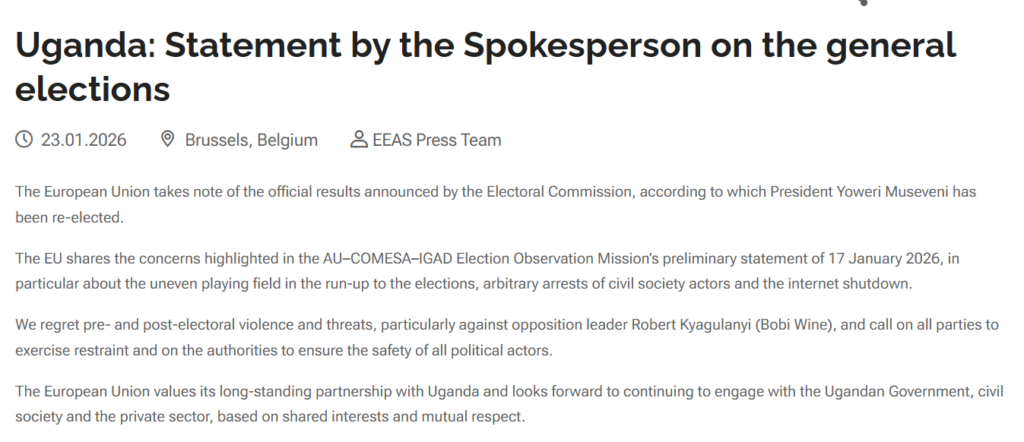
Comment: This answer lacks credibility. The EU commission statement of January 23 (screenshot above) was very short and refused to pinpoint the origin of the violence: the security forces of Yoweri Museveni. The US government and EU parliament did come out with strong statements condemning the lack of credibility of these elections.
Question 3
What is your assessment of the role and statements of General Kainerugaba, who has used social media to threaten opposition leader Bobi Wine (among others) and repeatedly boasted about the torture and detention of political opponents—including Bobi Wine’s head of security and bodyguard, Eddy Mutwe—and who has publicly stated that security services have killed opposition members?
Answer
The increasing involvement of the military in civilian institutions, as noted in the statement by the UN High Commissioner for Human Rights, is a cause for concern. General Kainerugaba’s statements on social media do not contribute to de-escalation. This matter has been discussed with the Ugandan authorities.
Comment: Again, this is a very weak response by the Ministery. Kainerugaba is generally considered volatile and unpredictable. The use of the word ‘de-escalation’ suggests a both-sideism view which doesn’t reflect that all violence and escalation comes from one side: the Ugandan government.
Question 4
Are you prepared to consider—whether within an EU framework or otherwise—targeted sanctions against individuals responsible for these human rights violations?
Answer
The government is not currently considering sanctions; instead, it prefers to maintain a dialogue with the Ugandan authorities and consistently raise the issue of human rights violations during regular contacts. The Netherlands also continues to support Ugandan civil society organizations (see also the answer to question 10).
Comment: Again, this response lacks credibility. I’ve rarely seen any interactions of Dutch government officials with Human Right Defenders or Opposition activists. The Dutch government is aware this would annoy the Ugandan leadership and therefore refrains from it.
Question 5
Are you prepared to advocate—both bilaterally and within the EU—for the immediate release of Kizza Besigye, who has been detained without trial for nearly two years on an alleged charge of high treason and who ended up in intensive care in a critical, life-threatening condition in late July 2026 after collapsing during his trial? Are you prepared to urge the Ugandan authorities to grant Besigye access to independent medical care?
Answer
The case of Kizza Besigye, including his medical situation, is part of ongoing discussions that the Netherlands and the EU are holding with Ugandan authorities regarding the human rights situation. See also the answer to Question 2. Through support for the International Development Law Organization (IDLO) and the United Nations Office on Drugs and Crime (UNODC), as well as local organizations such as BarefootLaw, the Netherlands continues to promote access to justice, focusing—among other things—on an independent judiciary, the timely handling of court cases, and improved prison conditions in Uganda.
Question 6
Are you prepared to advocate within the EU for a joint, independent investigation into the conduct of these elections, and for making any EU aid to Uganda conditional upon the findings of such an investigation?
Answer
In the run-up to the January 2026 elections, the EU decided not to send an observation mission. However, the African Union (AU), the Common Market for Eastern and Southern Africa (COMESA), and the Intergovernmental Authority on Development (IGAD) did conduct a joint election observation mission; while this mission did not identify large-scale irregularities, it did express concerns regarding issues such as an uneven playing field, intimidation, and arrests. An observation mission by the Uganda Law Society reached similar conclusions. As mentioned in the answer to Question 2, the EU issued a statement expressing concern about the conduct of the elections and calling on the Ugandan authorities to ensure the safety of political actors. The government therefore sees no grounds for an additional investigation.
Comment: Only 5 countries in de African Union are considered democratic according to Freedom House, so their report lacks credibility.
The suggestion that ULS did not identify large-scale irregularities is totally false. Their report is clear that these elections were neither Free nor Fair.
Also the report by AGORA documented the wide-spread violence and intimidation.
In 2021 I wrote a 200 page report on the Rigged elections, but the Ministry didn’t show any interest.
The pattern is clear; the Ministry cherrypicks those reports that defend their development partner.
The 2026 ‘election’ is the first time that no tally has been published which clearly shows the regime cannot explain how it announced Museveni to have won with 71% of the vote and neither can it explain why the opposition leader Bobi Wine had to be chased away if he only had 24% of the votes.
Question 7
Can you provide an overview of current bilateral cooperation with Uganda, including ongoing initiatives in the areas of migration, security, trade, and development cooperation? Are you prepared to review this cooperation in light of the above? If not, why not?
Answer
The Netherlands is active in Uganda across a wide range of policy areas. Priority themes for Dutch engagement include food security, water management, and health, as well as migration and the promotion of security and stability. In this way, the Netherlands seeks to contribute to a stable, prosperous, and democratic Uganda, thereby simultaneously serving Dutch interests regarding migration, trade, and security. For instance, Dutch food security programmes work to improve production, income, and access to finance for smallholder farms, as well as to strengthen local farmers’ cooperatives. This enables Dutch entrepreneurs to source raw materials locally while simultaneously creating a market for these farms.
Regarding migration, the Netherlands supports Uganda’s open policy on hosting refugees. The Prospects partnership contributes to the self-reliance and inclusion of refugees and host communities in Uganda.
Dutch initiatives to promote security and stability focus on areas such as accountability, governance, and civic participation; conflict prevention; local social cohesion; and strengthening the rule of law, equal access to justice, respect for human rights, and conflict prevention.
The government does not currently consider it desirable to halt Dutch engagement in Uganda or cooperation with the authorities. Doing so would mean withdrawing Dutch support for civil society—support that is crucial given the restrictions on fundamental freedoms. Furthermore, the government believes that broad cooperation with Uganda actually facilitates dialogue on human rights and fundamental freedoms. As outlined in the Foreign Affairs policy letter, the Netherlands champions fundamental freedoms worldwide and builds equitable partnerships through its Africa Strategy. By continuing to cooperate on shared interests, we can more effectively engage in dialogue on issues where our views are less aligned.
Question 8
What safeguards are in place to prevent Dutch support or cooperation from contributing, directly or indirectly, to the aforementioned human rights violations?
Answer
All programmes and initiatives funded by the Netherlands include extensive safeguards to ensure they do not contribute (directly or indirectly) to human rights violations. This is continuously monitored by the government as well as by the implementing partners themselves. If there are indications that activities are contributing—directly or indirectly—to human rights violations, the matter is carefully assessed. Where necessary, mitigating measures may be taken, including the suspension or termination of funding. There is currently no indication that Dutch support or cooperation is contributing, directly or indirectly, to human rights violations in Uganda.
Comment: I have no way of verifying the statements in this reply, but can confidently say that the way the Netherlands and the EU look away from Human Rights violations emboldens the regime to continue in the same way.
Question 9
What opportunities do you see for taking a stand—together with like-minded EU Member States—against the gradual erosion of the rule of law and for the protection of fundamental freedoms in Uganda?
Answer
The Netherlands works closely with other EU Member States to convey joint messages regarding the rule of law and fundamental freedoms to the Ugandan authorities, and will continue to do so. As noted in the answer to Question 2, EU Member States jointly conveyed their concerns to the Ugandan authorities in July 2026 regarding the closure of the National Media Group and urged its reopening. These topics will also be addressed during the EU partnership dialogue with the Ugandan government, which is due to take place soon.
Comment: Again, statements by EU commission and Netherlands are rare and consistently weakly formulated.
Question 10
Are you prepared to examine how independent support for human rights defenders, journalists, and civil society in Uganda can be increased, particularly in light of the restrictions imposed on international funding by the “Protection of Sovereignty Act”? Are you also prepared to explore how the Netherlands can specifically contribute to the protection and reception of Ugandan political refugees? If not, why not?
Answer
In the Foreign Affairs policy letter, we indicate our intention to step up efforts regarding democratization and good governance and to forge partnerships with civil society. Your House will soon be informed in greater detail about the specific implementation of this. In Uganda, the Netherlands provides broad support to civil society, human rights defenders, and journalists. In addition, the Netherlands is currently working on further initiatives to promote meaningful youth participation in democracy and policy processes.
At the same time, much remains unclear regarding exactly how the Protection of Sovereignty Act will be implemented and what impact this will have on Dutch and EU efforts. The Netherlands is monitoring the situation together with other EU member states and maintains ongoing contact with the government and local partners regarding this matter.
Regarding contributions to the protection and reception of political refugees, we can inform your House that the asylum application of anyone claiming to be eligible for international protection on the grounds of political refugee status will be carefully assessed on its individual merits within the asylum procedure. Every asylum seeker is entitled to reception facilities during the asylum procedure.
Comment: Netherlands does not provide assistance for Human Rights Defenders. When Human Rights advocate Kakwenza and myself visited the Ministery of Foreign Affairs and presented our 1500 pages ICC submission with 217 statements detailing the Human Rights crisis we were met with apathy and told that time was up. The Ministry was not interested in receiving a copy.
Where the Dutch government supports Ugandan journalists, these are almost always working for media outlets controlled by the regime like NBS, UBS. I’ve personally met journalists part of a course “Fact Checking’ by a Dutch organisation and can confidently confirm that these journalists are actually the ones writing government propaganda in Ugandan media.
I don’t know of any case in recent years where the Dutch government has invited a political activist to come to Netherlands to be shielded from danger. A couple of years ago I requested such assistance for renowned blogger in exile Fred Lumbuye, but the Ministry was not willing to help.